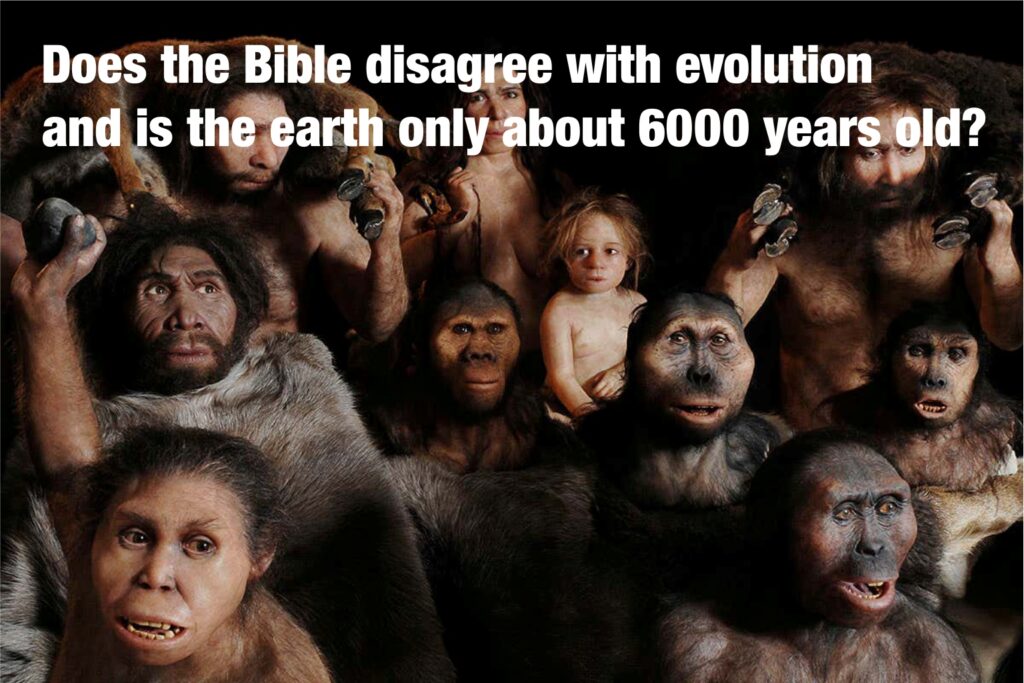
Short answer: YES
Here’s why…
This is a subject that can be (and has been) studied out enough to fill multiple volumes of books, but here we will keep it simple – there is no need to extrapolate the for-and-against views – we simply need to take the Bible in the literal sense it was intended.
This is an easy answer to prove using the Bible. Incredibly the Bible gives a genealogical account of every generation from Adam right up until Jesus. Not only that but it also gives the age of each preceding generation from Adam to Noah (Genesis 5) through to Joseph. Thus it can easily be calculated that from the creation of Adam until the flood of Noah was 1656 years. Then from the flood until the death of Joseph (who brought the Jews out of slavery from Egypt) was another 653 years making a total of 2309 years from creation day until the death of Joseph. Other scriptures, genealogies and historical records put the creation day at around 4004 years B.C. From there we can add another 2022 (at time of writing) years to put the age of the earth (including the universe) at 6026 years old (give or take a few years). See longevity chart here
Evolutionists aim to put the age of the earth in the millions in order to accommodate their false theory. They claim to use science but in actual fact their so-called science is merely ideology. Science involves experimenting and observing the result. Why do they call evolutionary theory science, when you cannot do experiments or even observe what has happened in the past? Has anyone ever observed a fish changing into another species, or a dinosaur changing into a bird? No. Evolution is a false claim because those that teach it have turned their backs on God and will not recognise the true creator of the universe.
There are incredibly complex biological systems at work in living things that cannot simply come about through a millions of years process of chance. Some examples are the blood clotting mechanism, the bacterial flagellum (used for propulsion), the photosynthetic apparatus, and the pupal transformation of caterpillars to butterflies.
The Human brain with its complex creative power for reasoning and with capabilities far beyond what is required for sheer survival is the most obvious reason for the need of a creator/designer.
Using the old watch story its easy to understand how life as we know it could only have been created by design and not evolve. A man is walking down a path when he looks down and sees a watch. He has never seen a watch before but he observes how the second hand ticks away precisely and he can see all the gears and cogs turning in a precise manner. He feels the smooth concave glass face and how it is set into the polished brass casing that has been fashioned with intricate carvings and filigree. In his reasoning as to how this watch came to be he makes two statements: first – The detailed brass body, polished glass face, gears, cogs and springs all somehow magically made themselves and brought themselves together, assembling themselves into a watch so that it keeps time perfectly with the movement of the earth. All this was done without intervention but was simply a process of time and chance. The second thought he has is – This is a watch, therefore there must be a watch-maker, someone who created it.
Which is the most logical reasoning do you think? Of course there must be someone who created the watch. The same goes for the earth, sun moon stars and the universe. How could something so complex, so precise and ordered, simply come into existence by chance? Well it didn’t. The universe exists – therefore there must be a creator who made it and the Bible tells us so.
The Bible opens up with this statement: “In the beginning God created the Heaven and the earth.” This marks the start of everything by God the creator – not evolution. As we read on from here, we have a six day account of the order of creation. Day one: The earth, water, light and darkness. Day two: the atmosphere with water above (the sky) and water below (ocean). Day three: Separation of water and dry land. Grass, plants and trees. Day four: Stars (including the Sun), planets, celestial bodies (including the moon). Day five: Sea creatures, Birds. Day six: Land animals, Mankind (Adam & Eve). Creation complete!
Genesis 1:31 “And God saw everything that He had made, and, behold, it was very good. And the evening and the morning were the sixth day.”
There are some that claim these six days are ‘eras of time’ (possibly thousands of years) not literal days (they are possibly trying to accommodate the lie of evolution into their biblical theory) and they generally quote 2Peter3:8 to back up their position (“…one day is with the Lord as a thousand years, and a thousand years as one day.”). This is an error in their understanding of scripture. This passage merely compares a day with a thousand years, not that a day is a thousand years. The Bible here is simply teaching that what might seem like a long period to us (i.e. a thousand years), to God it is but a day. This has nothing to do with the meaning of ‘day’ in Genesis 1. Another passage in Psalm 90:4 compares a thousand years to a watch in the night (i.e. a few hours), yet no one claims a watch could last a thousand years. Psalm 90 as with the one in 2Peter aptly express the disproportion that exists between Almighty God who is immortal and mankind who is mortal.
One problem (amongst many others) that arises with the extended time scale of a ‘day’ is the pollination of plants. Plants were created on day three whilst insects which are needed for pollination, were only created on day six. If these days were eras of thousands of years, then how were plants pollinated to ensure their survival until the insects came along?
We simply need to read further in the Bible to find the passage from Exodus 20:11 “For in six days the Lord made heaven and earth, the sea, and all that is in them.” God took six days to make everything.
It is also worth noting that the word ‘day’ is used with a number (i.e. first day, second day etc) throughout Genesis and 410 times outside of Genesis – each time referring to a 24 hour day. ‘Evening’ and ‘morning’ are used together without ‘day’ 38 times outside Genesis 1 and it always indicates an ordinary day. ‘Evening’ or ‘morning’ are used 23 times each with ‘day’ outside of Genesis 1 and it always means an ordinary day. ‘Night’ is used with ‘day’ 52 times and it always indicates an ordinary day. The days in Genesis 1 are ordinary 24 hour days – not elongated or extended periods of time.
Exodus 20:11 “For in six days the Lord made Heaven and Earth, the sea, and all that in them is…”